
No. Mild cases and tritan (blue-yellow) deficiency can be missed. Use the Color Blind Test or a clinical exam for a broader check.
Your Ishihara Test Results
Ishihara screening focuses on red-green discrimination with numbered plates and optional tracing plates. This page explains how BlindnessTest scores those plates and shows your saved run when available.
Ishihara Test
You haven't taken this test yet
This page shows your detailed screening result after you complete the test in your browser. Results stay on this device only and are never uploaded.
What you will get on this page
Finish an Ishihara run and this page becomes your plate-by-plate report. Here is what it will contain.
Plate counts for every section
A summary card with your screening plate score, plus classification and tracing counts when those sections were included, and the overall red-green pattern they suggest.
A protan versus deutan lean
When classification plates are part of the run, an axis meter shows whether your answers leaned red-weak or green-weak, with each count explained in one plain sentence.
A personal reading you can act on
A written walkthrough of what your plate pattern means, how red-green difficulty tends to show up day to day, and when a retake or a professional check makes sense. Downloadable as a PDF report.
Results that never leave this device
Your plate answers are saved in this browser only. Nothing is uploaded, there is no account, and one click clears the saved run whenever you want.
The sections below explain how the plates and their scoring work, so the counts will make sense the moment you finish.
How this test works
The famous dot plates have a clever trick built into them. Here is what it is.
The number hides along a confusion line
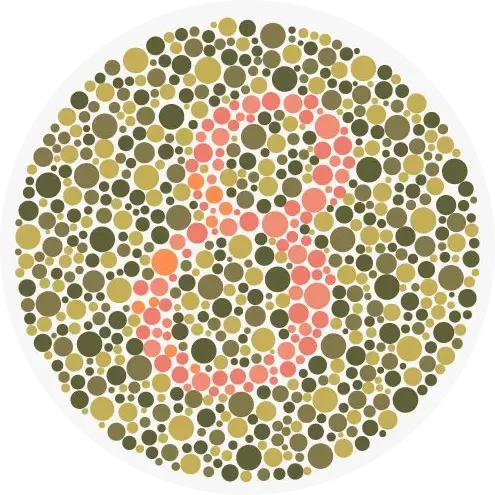
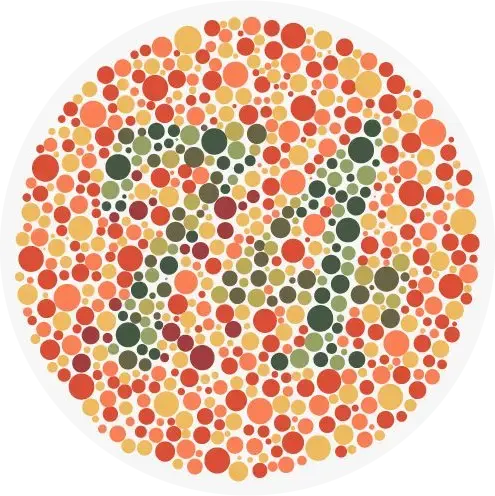
Each plate is a field of dots, like the one shown here. The dots that form the number and the dots around it differ only in colors that sit along the red-green confusion line.
Typical vision separates those colors instantly, so the number pops out. Red-green deficient vision sees them as nearly the same, so the number fades into the background or even flips into a different digit.
Dot sizes and brightness are deliberately mixed up. That removes every other clue, leaving color as the only way to read the figure.
Why one wrong plate is not a verdict
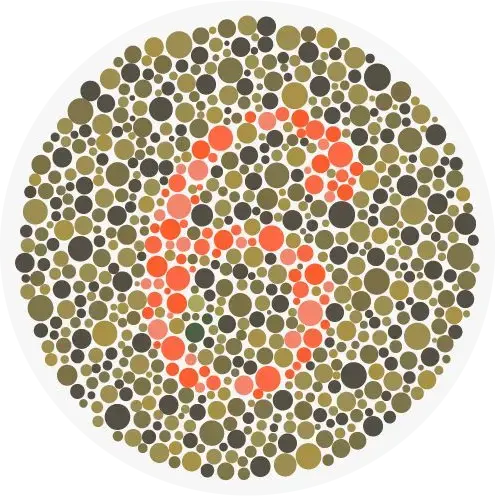
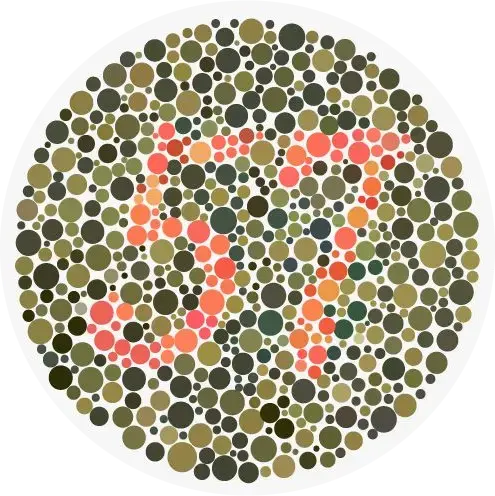
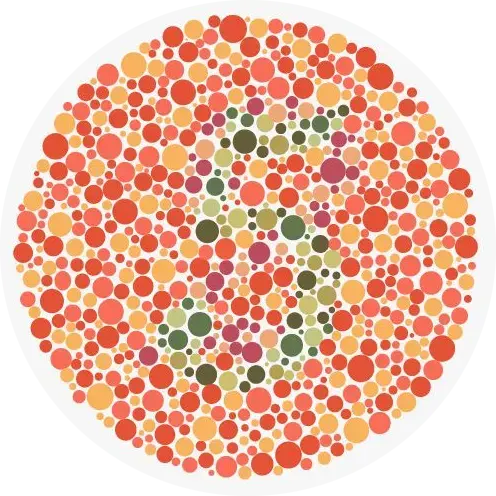
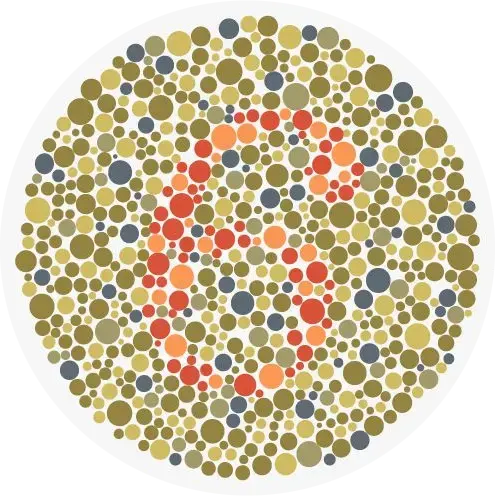
A single missed plate can come from glare, a dim screen, or plain haste. The result only becomes meaningful as a pattern across the whole set, like the mix of hits and misses in this diagram.
Different plates probe slightly different confusions, so where the misses land matters as much as how many there are. Misses that cluster on the same kind of plate say more than scattered ones.
That is why the test reports plate counts by section instead of a single pass or fail, and why a careful retake matters when a run lands near the boundary.
How scoring works
Ishihara-style screening checks whether you read hidden numbers (or paths) the way typical red-green vision usually does on this plate set.
Step 1
Start with the demonstration plate
Plate 1 should show 12 for most people with a working setup. If that plate fails, fix brightness and glare before trusting the rest of the run.
Step 2
Screening plates count typical versus alternate readings
After the demo, screening plates (often plates 2 to 21) score how many answers match expected typical readings versus common red-green alternate readings.
Step 3
Classification plates can suggest a lean
When screening looks deficient, classification plates (often 22 to 25) tally protan-leaning versus deutan-leaning responses. That lean is a hint, not a clinic type.
Step 4
Tracing plates use a drawn path
Tracing plates (often 26 to 38) ask you to follow a path instead of typing a number. There is no single accuracy percent across every plate group. Labels describe screening patterns only.
What each classification means
Typical red-green responses
Your screening answers matched expected patterns for this online Ishihara set. Mild differences can still exist.
Borderline
Your score sat near the pass/fail boundary. Retest with ideal display settings or seek professional testing if decisions depend on the result.
Red-green difficulty suggested
Screening answers diverged from typical patterns. Classification or tracing sections may refine whether a protan or deutan pattern appears.
Protan or deutan pattern
Classification or tracing plates suggested a stronger lean toward one axis. Online typing is still only a screen.
Plate groups
Demonstration plate 1 should show 12 for most users with a working setup. Screening, classification, and tracing sections are reported separately so you can see where errors clustered.
What can change your score
Online color tests run on everyday phones and monitors. These limits apply to every result on this site. Ishihara is weaker for blue-yellow issues, so a normal plate run does not rule out tritan difficulty.
Your screen is not a clinic display
Brightness, color temperature, Night Shift, True Tone, and browser color handling all change what you see. The same person can score differently on two devices.
Room light and glare matter
A bright window, dim room, or reflections on a glossy screen can hide or exaggerate colors. Steady indoor light and full brightness give the fairest retake.
Glasses and filters can shift results
Tinted lenses, blue-light filters, and accessibility color filters can move scores without reflecting a lasting vision change. Retake without them when you want a cleaner check.
This is screening, not a diagnosis
These tools help you understand a pattern and plan next steps. They are not a medical diagnosis, treatment advice, or clearance for a job or license.
What to do next
- 1
Retake under ideal conditions
Use 100% brightness, turn off Night Shift or True Tone, remove tinted lenses, and sit in steady indoor light before repeating the test.
- 2
Compare with another screening tool
Different tests ask different questions. Plate tests, hue arrangement, matching, and lantern naming can disagree on mild cases.
- 3
See an eye care professional when it matters
Online results are for awareness and education. Occupational certification and clinical diagnosis need supervised in-person testing.
Frequently Asked Questions
Common questions about Ishihara Test scoring, saved results, and limits of online screening.
Ready to screen with plates again?
Retake the Ishihara Test, or compare with another tool from your profile hub.