
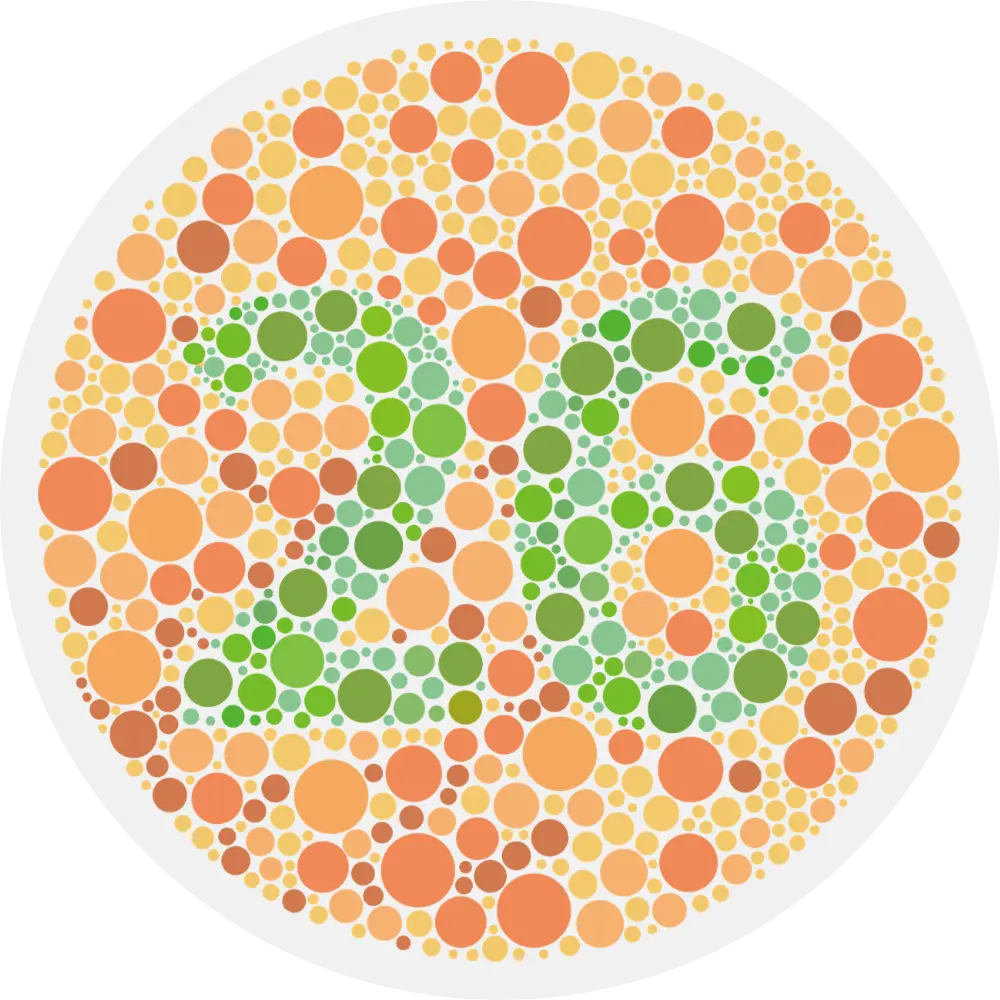
The Ishihara test is a pseudoisochromatic plate screen used to detect red-green color vision deficiency. Figures are hidden in colored dot fields. BlindnessTest follows the Kanehara 38-plate edition structure with numeric and tracing paths.
Ishihara Test
Take a free online Ishihara test for red-green color vision screening, built on the Kanehara 38-plate edition structure. Numeric plates 1 through 21 screen your color vision. Optional plates 22 through 25 classify the pattern when screening suggests a deficiency, and a separate line-tracing path on plates 26 through 38 serves people who cannot read numerals.
Take the Ishihara Test
Choose numbers or line tracing on the welcome screen, then follow the on-screen prompts. Your sectioned result appears when the run completes.
Ishihara Test
Ishihara screens red-green color vision only, not blue-yellow: read each plate and enter the number you see, or choose tracing if a line is easier.
The Ishihara test remains one of the most recognized red-green color vision screens worldwide. Clinicians still use printed plate books under controlled daylight, but many people first encounter Ishihara plates online on a phone, tablet, or monitor.
BlindnessTest maps the full Kanehara 38-plate edition structure: a demonstration plate, twenty screening plates, four optional classification plates, and thirteen tracing plates. The default adult path runs plates 1 through 21 and adds 22 through 25 only when screening suggests deficiency. You can also start the tracing path directly if you cannot read numerals.
This tool reports screening patterns consistent with typical trichromat responses or red-green difficulty. It does not grade severity on a percentage scale. For separate red, green, and blue channel scores, follow up with the Color Blind Test after you finish here.
How Does the Ishihara Test Work?
Each Ishihara plate is a field of colored dots. For numeric plates, a figure is encoded in hue difference rather than brightness alone. People with typical red-green discrimination usually read the intended numeral quickly. Many people with inherited red-green deficiency misread the figure, report nothing on hidden-digit plates, or see a different digit on transformation plates.
The Kanehara 38-plate book groups plates into six functional types, from demonstration and screening numerals through optional classification and a separate tracing path. See the 38-plate map and answer reference sections below for plate-by-plate detail.
BlindnessTest scores screening using the Kanehara count on plates 2 through 21: seventeen or more typical responses suggest normal screening, thirteen or fewer suggest deficiency, and fourteen to sixteen are borderline. Plate 1 is excluded from that count. If you enter a two-digit answer on classification plates, the tool may ask whether you also see a faint second numeral. That extra check supports mild axis hints.
Two entry paths exist on the welcome screen. Start Number Test begins the numeric queue. Start Tracing Test opens a short practice plate, then plates 26 through 38 with a finger or mouse stroke on a canvas overlay.
History of the Ishihara Test
Dr. Shinobu Ishihara, a Japanese ophthalmologist, introduced pseudoisochromatic plates in 1917. Each plate is a field of colored dots in which a numeral or path is carried by hue difference rather than by a simple brightness edge.
The method became a standard first screen for inherited red-green color vision deficiency because it is quick, inexpensive, and easy to administer. Printed Kanehara editions remain common in clinics, schools, and occupational screening, usually under daylight-like lighting at a set viewing distance.
BlindnessTest reproduces the Kanehara 38-plate structure on digital WebPs for educational screening. Online plates cannot replicate ink pigments or examiner supervision, but they help you learn the method before an in-person exam.
How to Prepare for Plate Screening
Ishihara plates respond to how your screen renders hue. These steps mirror common clinic prep adapted for online use. In formal clinics, plates are often viewed under daylight-like illumination near D65 color temperature with even, neutral light. Open Settings on the welcome screen to pick the Standard or Full number test, or start line tracing, before you begin.
- Set screen brightness to 100 percent when possible.
- Turn off Night Shift, True Tone, blue-light filters, and color-correction or accessibility tint apps.
- Use even indoor or daylight-neutral lighting without strong colored lamps behind you.
- Sit at arm's length with the display flat and viewed straight-on. Reduce glare on the panel.
- Remove tinted lenses for the run. Keep everyday prescription glasses on if you normally wear them.
- Complete the run in one sitting. Printed Kanehara books often use about 3 seconds per numeric plate; choose 5, 10, 15, or 20 seconds in settings for online screening.
What Your Ishihara Results Mean
Results are sectioned by phase: screening on plates 2 through 21, optional classification on 22 through 25, and optional tracing on 26 through 38. Labels describe screening patterns, not a clinical diagnosis. There is no single accuracy percentage across all plates.
Screening reports how many of twenty plates matched typical trichromat answers. The modal labels the run normal, borderline, or deficient using Kanehara thresholds in the table above. Plate 1 is demonstration only. If you miss plate 1, the tool suggests a setup retry rather than labeling the whole run invalid.
Hidden-digit plates 18 through 21 invert the usual pattern. Reporting Nothing counts as a typical answer. A reported digit counts against screening only when you also missed at least two vanishing plates on 10 through 17.
When classification runs, protan-type and deutan-type signal counts summarize plates 22 through 25. Mild dual-digit follow-up may adjust axis hints when you report a faint second numeral. Unclear or mixed patterns are reported without forcing a definitive type label.
When tracing runs, the modal reports how many tracing plates passed automated stroke checks and whether plate 38 registered as a control. Tracing here uses zone-based validation, not full printed-clinic path masks, so treat tracing output as supportive screening.
Borderline screening from fourteen to sixteen typical responses deserves a retest in ideal conditions. Mild anomalous trichromacy may still pass screening online. For channel percentages and severity bands, continue with the Color Blind Test.
Occupational, aviation, and school certification require supervised edition-specific testing. Use this result to start an informed conversation with an eye care professional or to decide whether formal testing is needed.
Kanehara-style screening on plates 2 through 21 (plate 1 excluded)
| Typical responses (of 20) | Screening label | What happens next on this site |
|---|---|---|
| 17 or more | Typical color vision (screening) | Result modal after plate 21; plates 22 to 25 skipped in Standard mode |
| 14 to 16 | Borderline | Borderline label; retest recommended; classification skipped in Standard mode only |
| 13 or fewer | Deficient pattern suggested | Plates 22 to 25 append for protan-type vs deutan-type hints |
Test Settings Explained
Number test
Standard runs the demonstration plate plus screening plates 2 through 21, and adds classification plates 22 through 25 only when screening suggests a deficiency. Full always includes plates 22 through 25. The line-tracing path (plates 26 through 38) is a separate button on the welcome screen, so you can start it in either mode.
Time per plate
Printed Kanehara books often allow about 3 seconds per numeric plate and about 10 seconds per tracing plate. BlindnessTest defaults to 15 seconds online for comfortable reading. Choose 5, 10, 15, or 20 seconds per plate, or turn the timer off. The same time applies to number and tracing plates.
Plate order
Random shuffles within each phase bucket while keeping plate 1 first on numeric runs. In order follows Kanehara numbering inside each phase. Classification and tracing queues shuffle separately from screening.
Plate counter
Show displays current plate index during the run. Hide removes the counter for a cleaner view. The counter reflects queue length, which may grow if classification or tracing phases append.
Saved preferences
Timer, number test, plate order, counter, and background choices persist in local browser storage on the same device. Open Settings on the welcome screen to adjust them before you start.
38-Plate Answer Reference (Plates 1 Through 38)
This reference shows Kanehara answer patterns for numeric plates 1 through 25 and tracing plates 26 through 38. Typical trichromat responses match normalVision flags on numeric plates. Red-green deficient patterns match redGreenVision flags on screening plates.
Plate 1 is demonstration only and is excluded from the screening count. Classification plates 22 through 25 run only when screening suggests deficiency, unless you choose the Full number test in settings. Tracing plates use line paths instead of numerals.
Screening and demonstration plates (1 through 21)
| Plate | Type | Typical trichromat | Red-green deficient pattern |
|---|---|---|---|
| 1 | Demonstration | 12 | 12 |
| 2 | Transformation | 8 | 3 |
| 3 | Transformation | 6 | 5 |
| 4 | Transformation | 29 | 70 |
| 5 | Transformation | 57 | 35 |
| 6 | Transformation | 5 | 2 |
| 7 | Transformation | 3 | 5 |
| 8 | Transformation | 15 | 17 |
| 9 | Transformation | 74 | 21 |
| 10 | Vanishing | 2 | Nothing |
| 11 | Vanishing | 6 | Nothing |
| 12 | Vanishing | 97 | Nothing |
| 13 | Vanishing | 45 | Nothing |
| 14 | Vanishing | 5 | Nothing |
| 15 | Vanishing | 7 | Nothing |
| 16 | Vanishing | 16 | Nothing |
| 17 | Vanishing | 73 | Nothing |
| 18 | Hidden digit | Nothing | 5 |
| 19 | Hidden digit | Nothing | 2 |
| 20 | Hidden digit | Nothing | 45 |
| 21 | Hidden digit | Nothing | 73 |
Classification plates (22 through 25)
| Plate | Typical trichromat | Protan-type (strong) | Deutan-type (strong) |
|---|---|---|---|
| 22 | 26 | 6 | 2 |
| 23 | 42 | 2 | 4 |
| 24 | 35 | 5 | 3 |
| 25 | 96 | 6 | 9 |
Tracing plates (26 through 38)
| Plates | Typical trichromat | Protan-type (strong) | Deutan-type (strong) | Role in Kanehara book |
|---|---|---|---|---|
| 26–27 | Trace both purple and red winding lines between side marks | Purple line only | Red line only | Dual-path axis hints for non-readers |
| 28–29 | Cannot trace hidden path (most observers) | Can trace winding line | Can trace winding line | Inverted tracing screen for non-readers |
| 30–31 | Trace bluish-green winding path | Wrong path or cannot trace | Wrong path or cannot trace | Color-specific tracing screen |
| 32–33 | Trace orange winding path | Wrong path or cannot trace | Wrong path or cannot trace | Color-specific tracing screen |
| 34–35 | Blue-green path plus yellow-green connector | Blue-green plus purple connector | Blue-green plus purple connector | Multi-segment tracing comparison |
| 36–37 | Purple path plus orange connector | Purple plus blue-green connector | Purple plus blue-green connector | Multi-segment tracing comparison |
| 38 | Trace prominent orange control path | Trace same control path | Trace same control path | Session control to confirm tracing task |
Ishihara Book Editions Compared
Kanehara publishes more than one Ishihara plate book. They share the same pseudoisochromatic method, but plate counts and numbering differ. BlindnessTest implements the full 38-plate Kanehara map with numeric plates 1 through 25 and tracing plates 26 through 38.
If you have taken a shorter clinic or occupational screen, the plate number on your form may not match the plate number in this online tool. Always compare edition type before interpreting a result side by side with a prior exam.
Kanehara Ishihara editions (do not mix plate numbering)
| Edition | Total plates | Numeric plates | Tracing plates | Notes on this site |
|---|---|---|---|---|
| Full (BlindnessTest) | 38 | 1 through 25 | 26 through 38 | Our WebP plates, answer keys, and phased flow follow this Kanehara map. |
| Abbreviated | 24 | 1 through 17 | 18 through 24 | Different plate numbering. Do not apply 24-plate pass rules to our 38-plate assets. |
| Concise | 14 | Screening subset | None | Sometimes used for quick occupational screens. Thresholds differ from the full 38-plate book. |
38-Plate Map: Six Functional Types
The Kanehara full edition orders thirty-eight plates into six functional groups. Numeric screening uses plates 2 through 21 after the demonstration plate. Classification plates 22 through 25 run only when that screening suggests deficiency. Tracing plates 26 through 38 use line paths for observers who cannot read numerals.
The diagram below shows how plate numbers map to each group in the edition wired into BlindnessTest. Plate 1 is excluded from the screening score.
Kanehara 38-plate layout
1
2–9
10–17
18–21
22–25
26–38
Demonstration
Plates 1
Transformation
Plates 2–9
Vanishing
Plates 10–17
Hidden digit
Plates 18–21
Classification
Plates 22–25
Tracing
Plates 26–38
Kanehara 38-plate groups used on BlindnessTest
| Plate type | Plate numbers | Role in this tool |
|---|---|---|
| Demonstration | 1 | Everyone should read 12. Excluded from the screening count. |
| Transformation | 2–9 | Typical observers read one digit; many deficient observers read a different digit. |
| Vanishing | 10–17 | Digit visible to many typical observers; often missed by deficient observers. |
| Hidden digit | 18–21 | Typical observers often report nothing; many deficient observers report a digit. |
| Classification | 22–25 | Optional axis hints when screening suggests deficiency. |
| Tracing | 26–38 | Winding line paths for non-readers; separate tracing entry path. |
Classification Plates 22 Through 25
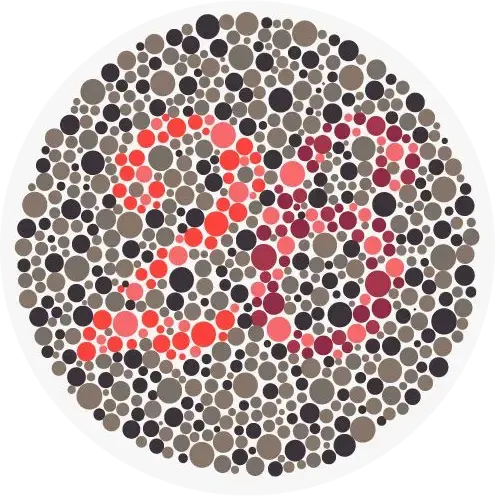
When screening on plates 2 through 21 suggests deficiency, plates 22 through 25 may append automatically. Typical observers usually report two-digit answers such as 26, 42, 35, and 96. Many protan-type and deutan-type patterns report a single digit that matches one half of the numeral.
Results describe protan-type or deutan-type patterns when multiple classification plates align. Unclear or mixed patterns are reported honestly. This is axis screening, not a formal diagnosis of protanomaly versus protanopia.
In practice, the digit a protan reader reports and the digit a deutan reader reports often differ, and that split is what lets these four plates separate the two red-green types. Because screen rendering varies from device to device, treat any pattern you see here as an axis hint rather than a fixed subtype, and confirm it with an in-person exam if it matters.
Tracing Plates and the Canvas Overlay
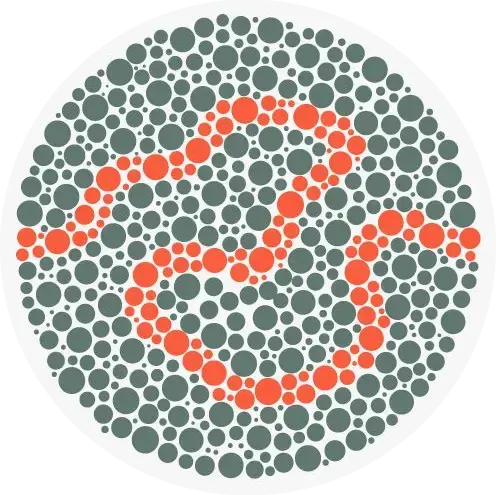
Tracing plates replace numerals with colored paths between X marks at the sides of the circle. You draw on a canvas layered over the plate image, then tap Check and next. Clear my line removes your stroke without reloading the plate.
Plate 38 is a control plate where most observers can trace the orange path. It helps confirm that you could complete the tracing task in this session. Tracing validation on this site uses start and end zone checks plus minimum stroke length. Printed clinic tracing is judged by an examiner, so online tracing is approximate screening only.
Tracing exists so the test still works for young children and for anyone who cannot name numerals. The colored path uses the same hue-difference principle as the numeric plates, so a red-green pattern that hides a numeral usually makes the winding line hard to follow as well. Draw the whole path in one continuous stroke for the cleanest automated result.
Red-Green Color Vision and Ishihara Plates

Most inherited color vision deficiency affects red-green discrimination through shifted L or M cone sensitivity. Ishihara plates remain a practical first screen for that axis but do not measure blue-yellow deficiency well and do not quantify severity.
Red-green deficiency is by far the most common inherited color vision difference, affecting about 1 in 12 men and 1 in 200 women. It traces to the L and M cone genes on the X chromosome, which is why it runs in families and shows up far more often in men than in women.
The pencil slider above hints at how the confusion can look, but a still image cannot capture how the effect shifts with lighting or with each person's degree of deficiency. Two people who both screen as red-green deficient may describe very different everyday experiences, which is one reason a single screening run is a starting point rather than a verdict.
If Ishihara screening looks typical but everyday color tasks still feel difficult, consider the Color Blind Test for channel scores or the Farnsworth-Munsell 100 Hue Test for finer hue arrangement detail.
Frequently Asked Questions
Limitations of the Online Ishihara Test
Digital vs clinic plates
This tool uses WebP plates on your display, not ink under exam-room lighting. Tracing uses automated stroke and side-zone checks, not an examiner with the printed plate. Results follow Kanehara-style rules but cannot certify occupational or aviation color vision.
Severity and borderline
Fail counts on Ishihara plates are a weak severity measure online. Mild protan or deutan patterns may still pass seventeen-of-twenty screening. Borderline scores from fourteen to sixteen deserve a retest under bright, neutral display settings.
Licensing and employment
Employers, aviation authorities, and schools require in-person, edition-specific color vision protocols. FAA initial pilot certification in the United States no longer accepts Ishihara alone. Use this tool for awareness, then complete the formal exam your regulator or employer requires.
Beyond red-green screening
Ishihara screens inherited red-green patterns only. It does not reliably detect tritan, or blue-yellow, deficiency. It also does not diagnose achromatopsia or total color blindness. Seek professional testing if color tasks outside the red-green axis still feel difficult.
Academic References and Clinical Context
BlindnessTest follows the Kanehara 38-plate edition: numeric plates 1 through 21, classification plates 22 through 25, and tracing plates 26 through 38, with the published answer keys and phase rules.
The sources below cover the plate method's design, its measured screening performance, and the occupational rules that govern formal testing. On-screen plates remain a screening adaptation of printed originals viewed under controlled light.
- Ishihara instruction text
Shinobu Ishihara's official plate instructions: the 75 cm viewing distance, three-second answer rule, and answer-key format the full 38-plate edition this tool follows also uses.
- Birch (1997)
Efficiency of the Ishihara test for identifying red-green colour deficiency. PMID 9390366. Establishes the plates' high sensitivity as a red-green screen.
- Rodriguez-Carmona et al. (2012)
Research on Ishihara plate performance and the variability of passing criteria across protocols. Informs our careful pass-band language.
- van Staden et al.
Comparison of computer-based and printed handbook Ishihara administration, the core caveat for any on-screen plate test including this one.
- National Eye Institute
Overview of color blindness, inheritance, and when to seek professional care.
- NHS Color Vision Deficiency
Patient-oriented summary of symptoms, testing, and living with color vision differences.
- American Academy of Ophthalmology
Clinical background on types of color blindness and diagnostic approaches.
- FAA AME Guide, Item 52
Aviation medical guidance on color vision testing in the United States, where plate screening is a first step, not a certification.
Can you read the hidden numbers?
Try the classic Ishihara plates to screen for red-green color blindness in just a few minutes.