
The Farnsworth Lantern Test (FALANT) is an occupational color vision test developed for the U.S. Navy in the 1940s. It shows brief vertical pairs of signal lights and asks the examinee to name each color. It screens practical signal-light naming for maritime, rail, and military roles rather than detecting every trace of color deficiency. This page recreates the task online with red, green, and yellow lights.
Farnsworth Lantern Test
Practice signal-light identification with this free online Farnsworth Lantern (FALANT) screening. Two stacked lights flash briefly, and you name each one as red, green, or yellow before the next pair appears. A run of 9 pairs takes about two minutes, and your result shows total correct lights, a per-color breakdown, and a screening band from normal through strong red-green difficulty.
Take the FALANT Test
Watch each pair of signal lights flash, then pick the top and bottom colors from red, green, and yellow. Start a Standard 9-pair run or an Extended 18-pair run.
Farnsworth Lantern Test
Name the two signal lights (red, green, or yellow) as they flash.
Plate tests ask whether you can find a hidden figure. Lantern tests ask a more practical question: when a colored light flashes at you, can you say what color it is? That is the skill a ship's officer, a rail worker, or a pilot actually uses at night, and it is the skill Commander Dean Farnsworth set out to measure when he built the New London Navy Lantern in the 1940s at the Naval Submarine Medical Research Laboratory.
The clinical Farnsworth Lantern Test, usually shortened to FALANT, shows two small lights stacked vertically, each red, green, or signal white, for about two seconds at roughly eight feet. The examinee names the top light and then the bottom one, nine pairs per run. The brief flash matters: given unlimited time, people with red-green deficiency can lean on brightness and context clues, and the lantern deliberately takes those away.
FALANT has an unusual design goal. Rather than catching every trace of color deficiency the way plate batteries try to, it was built to pass people whose color vision is good enough for signal work, including a share of mild red-green anomalous observers who fail Ishihara.
Studies place that share at roughly 20 to 35 percent of color-deficient examinees. Failing a lantern task therefore says something practical, not just theoretical.
This page recreates the task paradigm in your browser: stacked lights, a brief timed flash, and forced color naming, scored per light across a 9-pair or 18-pair sequence. It uses yellow as the third color, the common convention among online lantern simulators, where the clinical instrument uses signal white. Review test settings explained before you begin, or jump to what your results mean after a run.
How Does the Farnsworth Lantern Test Work?
Each trial shows two signal lights, one above the other, on the lantern panel. They stay lit for a short exposure (two seconds by default), then switch off, and the panel prompts you to pick what you saw. You choose a color chip for the top light and one for the bottom light, then submit, and the next pair loads. There is no time pressure on your answer, only on the viewing.
A Standard run presents 9 pair combinations drawn from red, green, and yellow, including same-color pairs, in a shuffled order. Every run contains each color exactly six times across its 18 individual lights, so no color can be avoided or guessed around.
The Extended option runs two shuffled 9-pair passes for 36 lights when you want a longer sample of your naming accuracy.
Scoring counts each light separately: a wrong name on one light is one error, so a fully misread pair costs two. Zero errors lands in the normal screening band on this tool. One or two errors is borderline, worth a careful retest. Three to five errors on a Standard run (three to eleven on Extended) suggests likely red-green difficulty, and more than that suggests strong difficulty. The result modal also breaks accuracy down by color, so you can see whether red, green, or yellow lights caused the trouble.
A few details of the clinical instrument are worth knowing. The real lantern begins each run with a red and green pair so the examinee sees those two colors before any white appears, and this tool does the same. The clinic device also places a fifty percent neutral-gray filter over its white light and over one light of each identical pair to strip away brightness cues; this version approximates that by dimming those lights on screen, though an uncalibrated display can never match a true neutral-density filter. The device is also no longer the last word in aviation: the U.S. Air Force dropped the FALANT in 1993 for missing cases it was never designed to catch, and approved computerized tests have since replaced it for pilot certification.
One honest caveat: the clinical pass rule is stricter and more elaborate than any single browser run. Occupational FALANT typically requires zero errors on a first 9-pair run, or an average of one error or fewer across two additional full runs. Treat the bands here as screening feedback, not an occupational verdict.
How to Prepare for Signal-Light Screening
Clinical lantern exams happen in a normally lit room, not in darkness, and this online version works the same way. A stable setup keeps the brief flashes readable and your color naming honest. Pick Standard or Extended on the welcome screen, and open Settings there to set exposure and background before you start.
- Use a normally lit room with neutral, steady lighting. Avoid total darkness, colored lamps, and glare on the panel.
- Turn off warm-tint modes: Night Shift and True Tone on Apple devices, Night Light on Windows, and Eye Comfort Shield or a similar mode on Android, along with blue-light filters and color-correction or accessibility tint apps. A warm tint pushes every light toward yellow.
- Set screen brightness to a comfortable, consistent level and view the display straight-on at arm's length.
- Remove tinted or color-corrective lenses for the run. Keep everyday prescription glasses on if you normally wear them.
- Answer with your first impression after each flash. Studying the panel after the lights switch off or replaying the pair in your head invites guessing.
- Complete the whole sequence in one sitting without switching tabs, and keep the same device and settings when comparing runs.
What Your Lantern Results Mean
Your result counts how many red, green, and yellow signal lights you named correctly across 9 or 18 pairs. Labels follow FALANT-style leniency heuristics on this tool, not clinical lantern hardware.
The result modal shows total correct lights, per-color breakdowns, and a screening label from pass through strong red-green deficiency. Only zero errors is labeled as normal screening on this tool; one or two errors is borderline, not an official FALANT pass.
Clinical FALANT uses white signal lights at regulated viewing distance. This browser tool uses yellow and uncalibrated RGB values, so labels describe performance here, not an official occupational pass.
Mild red-green deficiencies may pass some plate tests yet fail lantern-style tasks; a poor result here warrants professional follow-up even with prior normal screens. For separate channel scores, continue with the Color Blind Test.
Screening bands from signal-light errors on this tool (9 or 18 pairs)
| Incorrect lights | Screening label | What it means on this site |
|---|---|---|
| 0 | Normal red-green vision (screening) | Every red, green, and yellow light named correctly on this run. |
| 1 to 2 | Borderline screening | Not an official FALANT pass. Clinical protocols require zero errors on a first run, or ≤1 error average on two follow-up 9-pair runs. |
| 3 to about 30% of lights | Likely red-green deficiency | Several signal-light confusions suggest moderate difficulty. Professional follow-up recommended. |
| Above ~30% of lights | Strong red-green deficiency | Many misnamed lights on this screening tool. Not a clinical diagnosis; book an eye exam. |
Test Settings Explained
Light exposure
Controls how long each pair stays lit before the lights switch off: 2 seconds by default, with 3 or 5 seconds available. Shorter exposures are closer to the clinical protocol, because extended viewing lets brightness and afterimage cues leak into a task meant to test color naming alone.
Light pairs
Standard runs one 9-pair sequence (18 lights). Extended runs two shuffled 9-pair passes (36 lights) for a longer screening sample. Pick either from the welcome screen buttons. The pair count locks once a run starts; finish or restart to change it.
Practice mode
Choosing Practice instead of a timed exposure keeps the lights on until you answer. Use it to learn the task or help a child through it. Practice results are flagged in the result modal because untimed viewing does not match FALANT-style screening.
Background
The lantern panel background can be White or Black. Black gives the lights a stronger night-signal glow, closer to how maritime lights read at sea. Either is fine for screening; just keep the same choice when comparing runs.
Shuffled sequence
The nine pair combinations are fixed, but their order is shuffled every run, so you cannot memorize a sequence. Same-color pairs like red over red are included deliberately: calling both lights the same color is itself a decision the test wants to observe.
Saved preferences
Exposure, pair count, and background persist in your browser's local storage on this device. Scores are not stored between sessions, so note your errors and per-color accuracy if you want to compare a later run.
Why Signal Lights Are Hard With Red-Green Deficiency
A signal light is a small, saturated point of color with no surrounding context, often viewed briefly and at distance. That combination strips away every workaround a person with red-green deficiency normally uses. The sliders below show how the two main deficiency types, and the mild cases in between, change what a signal light looks like.
Protan Confusions: Red Loses Its Signal
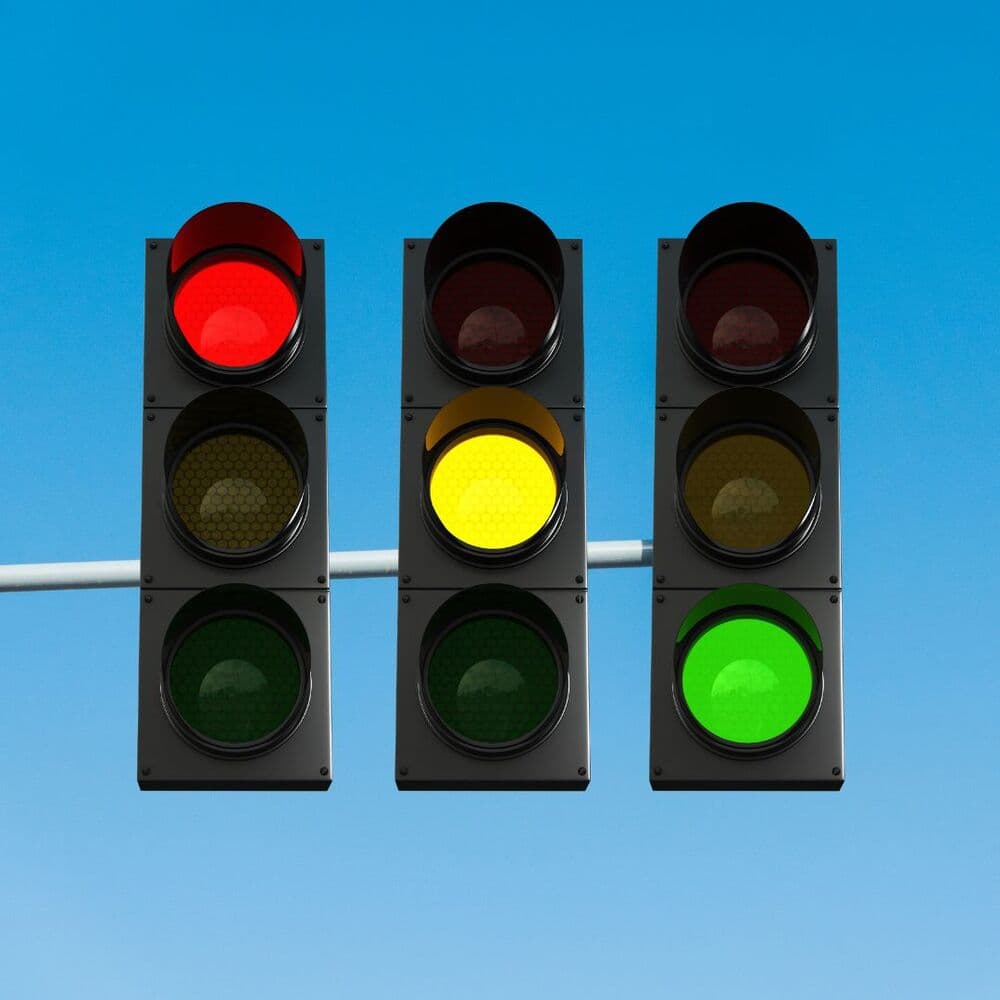
Protan deficiency comes from missing or shifted long-wavelength L cones. On a lantern task it produces two problems at once: red becomes hard to tell from green or yellow, and red light also appears genuinely darker, because much of a red signal's energy falls where a protan eye is least sensitive. A dim red at distance can fade toward nothing.
That dimming is why protan difficulty matters so much in transport roles, and it is also something an sRGB screen cannot fully reproduce. If your errors on this tool cluster on red lights, treat it as a strong prompt for professional testing rather than a curiosity.
It is worth remembering why ships and railways were among the first workplaces to screen color vision at all. A protan worker is not merely slower to name a red light: a distant red can fall below the threshold of visibility while a green of the same intensity still reads clearly, and that is a safety problem no amount of care can train away.
Because a screen cannot dim red the way a protan eye does, the online task tends to understate the real difficulty. For that reason, treat a run of red-light errors in the per-color breakdown as more significant than the raw error count alone would suggest.
Deutan Confusions: Green Drifts Warm
Deutan deficiency involves the medium-wavelength M cones and is the most common inherited form. Green lights drift toward amber and red, so a deutan observer may call a green light yellow, or hesitate between red and green on a mixed pair. Unlike protans, they do not experience reds as darker, which makes their errors purely about hue.
On this tool a deutan pattern usually shows up as mistakes spread across green and yellow lights in the per-color breakdown. The lantern task does not distinguish deutan from protan; for a type hint with separate channel scores, follow up with the Color Blind Test.
Deutan is the more common of the two red-green types, and on a lantern it tends to produce a subtler mix of errors than protan does. Rather than one color fading out, greens and yellows trade places, and a green light shown on its own, without a red beside it for comparison, is where a deutan observer most often hesitates.
The everyday fingerprint is errors spread across green and yellow lights combined with a normal sense of brightness, since deutan observers do not experience the red dimming that protans do. The lantern task will not label the pattern for you, but that spread is a useful thing to notice before a professional exam.
The Mild Cases That Can Still Pass
Anomalous trichromats have all three cone types, but one is shifted. In mild cases the shift narrows color differences without erasing them, so saturated signal colors often stay nameable even when subtle Ishihara plates do not. This is the group FALANT was designed to be fair to: about 20 to 35 percent of plate-test failers pass a clinical lantern.
If you fail plate screening but perform well here, that combination is meaningful and worth mentioning at a professional exam. The reverse also holds: errors on a lantern task after passing plates deserve follow-up, because signal naming under time pressure is its own skill.
This leniency is the point of a lantern, not a flaw in it. A worker with a mild shift who can still name every signal reliably is safe for the task, and a test that failed them would cost the service a capable person for no safety gain. That same design is why a good result here should never be read as ruling out a deficiency that a plate test or the Color Blind Test would catch, because the lantern is asking a narrower and more practical question than they are.
Two Lights, One Brief Flash
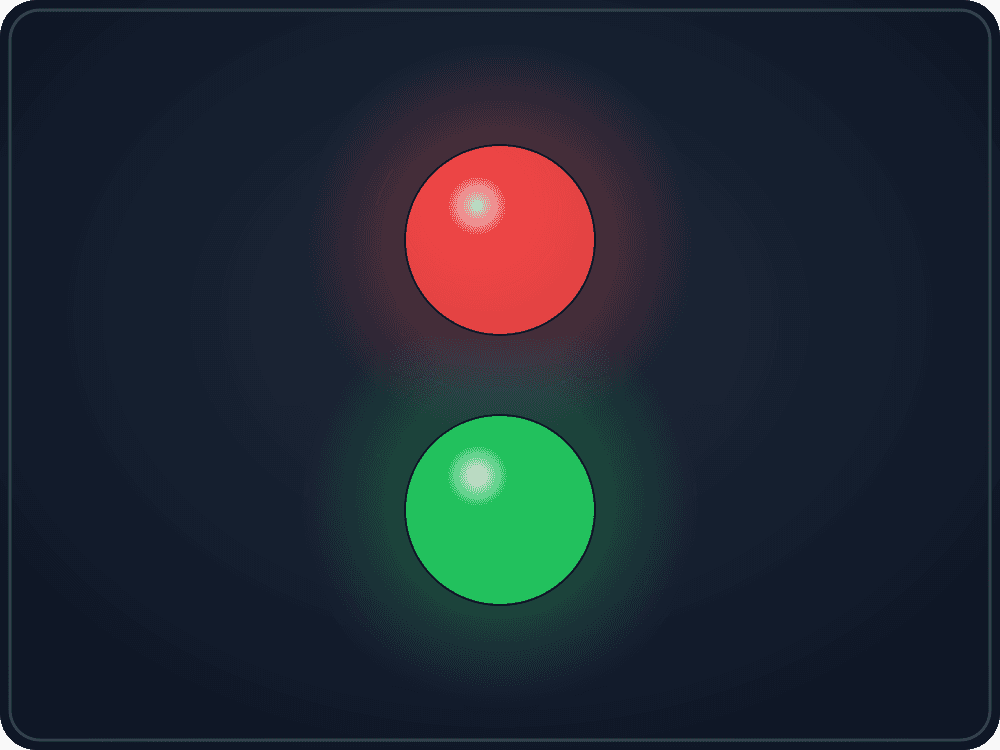
The whole test lives in this moment: two small lights, stacked vertically, lit for about two seconds. The stacked layout is deliberate. It forces you to judge each light on its own color rather than comparing the pair side by side, and it mirrors how paired navigation and rail signals are actually mounted.
When the flash ends, the lights switch off and only then can you answer. That ordering is the lantern's anti-guessing mechanism, kept intact in this online version: you name what you saw, not what you are still studying.
The stacked pair also mirrors a real approach at night, when a distant vessel or signal mast may show two lights and the safe response depends on naming both correctly and quickly. Getting the order right, top then bottom, is part of the task, so answer in that order here just as an examiner would expect at the lantern.
Nine Pairs, Six Lights of Each Color
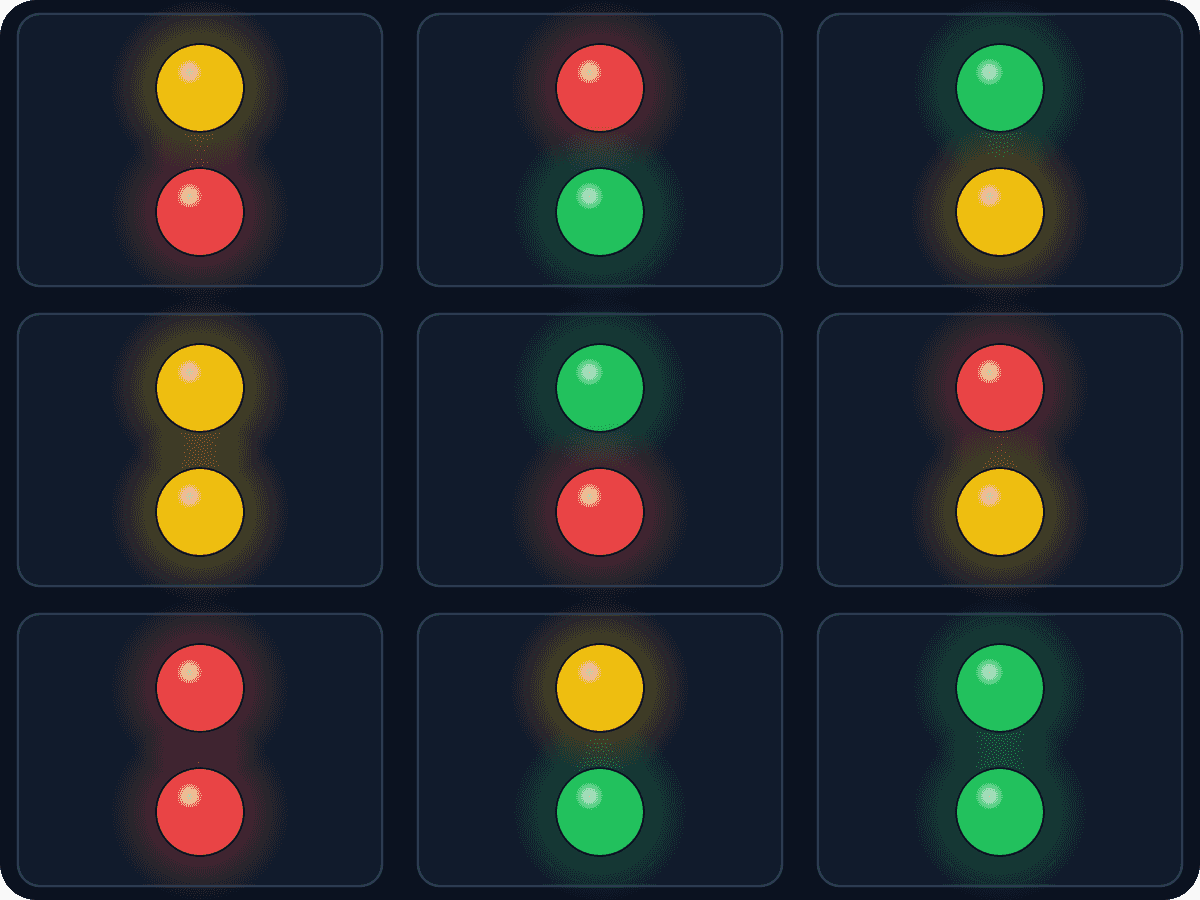
A run is built from nine fixed pair combinations of red, green, and yellow, shown here before shuffling. Mixed pairs test whether you separate the colors; same-color pairs test whether you trust your eyes when both lights match, a moment where uncertain observers often invent a difference.
Across the nine pairs, each color appears exactly six times among the 18 lights. That balance means a systematic confusion cannot hide: if green reliably drifts toward red for you, several of the six green lights will be misnamed, and the per-color breakdown in your result will show it.
The fixed set of nine also makes every run directly comparable to the next, since no color can appear more or less often by chance. If you repeat the test, keeping the same exposure and background lets you read a change in your per-color errors as a real change rather than an artifact of a different shuffle.
Frequently Asked Questions
Limitations of Online Lantern-Style Screening
Yellow vs clinical white
Clinical FALANT hardware uses signal white as the third color. This tool uses yellow, matching common online simulators. Browser results do not replicate calibrated white lantern light.
Sensitivity to mild deficiencies
Lantern tests may not detect mild red-green deficiencies, allowing some individuals with minor issues to pass. This is by design in occupational protocols but limits screening depth.
Display and environment
Uncalibrated monitors, Night Shift, ambient glare, and viewing distance shift how signal colors appear. Repeat on the same device under stable conditions if results surprise you.
Not for certification
FAA initial pilot color certification (2025+) uses CAD, RCCT, or WCCVT, not virtual FALANT. Maritime and other roles require proctored approved methods. Use this page for practice and private screening only.
Academic References and Clinical Context
This tool scores signal-light naming per light across a balanced 9-pair sequence, with screening bands adapted from FALANT-style pass heuristics rather than any regulator's protocol.
The sources below cover the lantern's naval origins, its measured performance with color-deficient observers, and the occupational rules that govern real certification. Browser results remain educational screening on an uncalibrated display.
- Farnsworth & Foreman (1946)
U.S. Navy Report No. 105 on the development and trial of the New London Navy Lantern as a selection test for serviceable color vision. The primary source for the task this page adapts.
- Paulson (U.S. Navy)
The Performance of the Farnsworth Lantern in Classifying the Color Vision of the Color Deficient. Documents how FALANT grades rather than simply detects deficiency.
- U.S. Navy Color Vision Standards Revisited
Naval review of color vision screening standards, including the lantern's role in personnel selection and its known leniency toward mild anomalous trichromats.
- Birch & Dain (1998)
Performance of the Farnsworth Lantern test in abnormal trichromats. Grounds our copy about which mild observers pass and which confusions cause failures.
- FALANT vs Optec 900 fail rates
Compares fail rates between the original lantern and its modern replacement among color-deficient cohorts, supporting the 20 to 35 percent pass-rate range cited here.
- FAA AME Guide, Item 52
Current U.S. aviation color vision rules. From 2025, new pilot evaluations use approved in-person computerized tests; virtual and legacy lantern tests are not accepted.
- 46 CFR § 10.305 (U.S. Coast Guard)
Merchant mariner medical certification rules listing the Farnsworth Lantern among acceptable in-person color vision examination methods for maritime credentials.
- 49 CFR Part 240, Appendix F (FRA)
U.S. railroad vision standards emphasizing recognition of signal colors, the occupational context in which lantern-style naming tasks are used.
- National Eye Institute
Patient-focused overview of color vision deficiency, its inheritance, and when to seek professional testing. Context for interpreting any screening result on this site.
Could you pass the lantern test?
Identify colored signal lights with the Farnsworth Lantern Test for aviation and maritime practice (not FAA certification).